
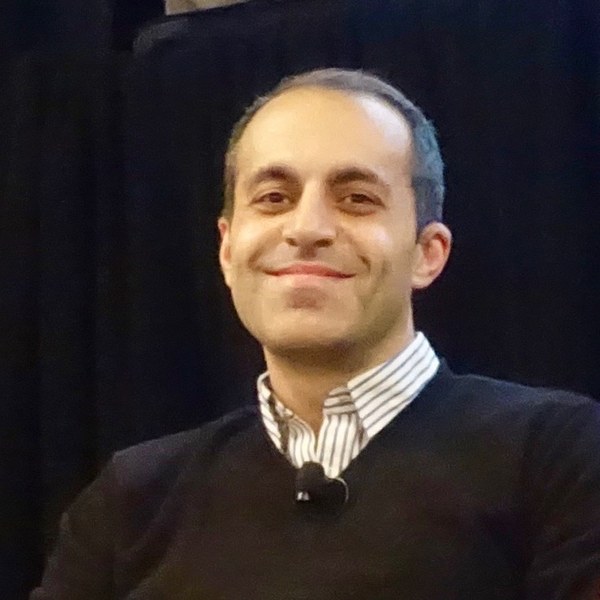
Ali Ghodsi is a Swedish-American computer scientist and entrepreneur who co-founded Databricks in 2013 and has served as its chief executive since 2016. The company commercializes Apache Spark, an open-source engine for large-scale data processing that Ghodsi helped create, and it has grown into a central platform for analytics, data engineering, and machine learning.
Before Databricks, Ghodsi spent his career in academic and industrial research on distributed systems and big data. He was part of the team at the University of California, Berkeley that started the Apache Spark project, and he co-authored several widely cited papers in the field. He remains an adjunct professor at UC Berkeley while running a company that, as of late 2024, had raised funding at a valuation in the tens of billions of dollars.
Who Ali Ghodsi is
Ghodsi was born in Iran in 1978 and was raised in Sweden, where he completed his education. He holds Swedish and American citizenship and is often described as one of the more research-driven chief executives in enterprise software, having come to business leadership from a background in computer science rather than from a traditional management track.
His work sits at the intersection of distributed computing and data infrastructure. He co-invented the concept of dominant resource fairness, an approach to allocating computing resources that influenced scheduling in systems such as Hadoop, and he contributed to foundational open-source projects including Apache Mesos and Apache Spark. That technical grounding shapes how he leads Databricks and how he speaks publicly about where data and artificial intelligence are heading.
Academic background and Apache Spark
Ghodsi received his PhD in 2006 from the KTH Royal Institute of Technology in Stockholm, where he studied distributed computing under the supervision of Seif Haridi. He earlier earned degrees from Mid-Sweden University, and he was an assistant professor at KTH from 2008 to 2009. Before academia turned into entrepreneurship, he was also a co-founder of Peerialism AB, a Stockholm company that worked on peer-to-peer data transfer.
In 2009 he joined UC Berkeley as a visiting scholar, working alongside researchers including Scott Shenker, Ion Stoica, Michael Franklin, and Matei Zaharia on distributed systems, databases, and networking. During this period he helped start the Apache Mesos and Apache Spark projects. Spark, originally developed by Zaharia, offered a faster and more flexible alternative to earlier big-data tools, and it became the technical foundation on which Databricks was later built.
Founding and leading Databricks
Databricks was founded in 2013 by a group of Spark creators and collaborators from Berkeley, including Ghodsi, Ion Stoica, Matei Zaharia, Reynold Xin, Patrick Wendell, Andy Konwinski, and Arsalan Tavakoli-Shiraji. The company set out to commercialize Spark by offering a managed cloud platform, sparing organizations the difficulty of running the open-source engine themselves.
Ghodsi initially served as vice president of engineering and product management. In 2016 he was named chief executive, taking over from co-founder Ion Stoica, who moved into the executive chairman role. Under Ghodsi the company expanded its platform well beyond Spark, promoting what it calls the data lakehouse, an architecture that combines features of data warehouses and data lakes. Databricks has raised a series of large funding rounds, including a round in December 2024 that the company said valued it in the tens of billions of dollars, making it one of the most valuable privately held software companies.
His role and views on data and AI
As chief executive, Ghodsi sets the strategy and public posture of a company that competes across data warehousing, analytics, and machine learning. He has positioned Databricks as a platform for building and deploying AI on an organization's own data, and the firm has acquired companies and released products aimed at generative AI and large language models. Readers comparing platforms in this space can find broader context in the guide to the best AI tools for business.
Ghodsi speaks frequently at industry events and in interviews about the practical adoption of data and AI inside enterprises, and he keeps a foot in the research community through his adjunct role at UC Berkeley. His career is often cited as an example of how an open-source academic project can become the basis for a large commercial business while its original creators stay closely involved in the technology.
Frequently asked questions
Who is Ali Ghodsi?
Ali Ghodsi is a Swedish-American computer scientist and entrepreneur who co-founded Databricks in 2013 and has been its CEO since 2016. He is one of the original creators of Apache Spark.
What did Ali Ghodsi do before Databricks?
He earned a PhD at the KTH Royal Institute of Technology in Sweden, was an assistant professor there, co-founded the company Peerialism AB, and then joined UC Berkeley in 2009, where he helped start the Apache Spark and Apache Mesos projects.
When did Ali Ghodsi become CEO of Databricks?
Ghodsi became chief executive of Databricks in 2016, having previously served as the company's vice president of engineering and product management after its founding in 2013.
Is Ali Ghodsi still connected to academia?
Yes. Alongside leading Databricks, he serves as an adjunct professor at UC Berkeley, where he was part of the research group that created Apache Spark. His Wikipedia biography details his research and academic record.
What is Databricks known for?
Databricks is known for commercializing Apache Spark and for promoting the data lakehouse architecture, which combines elements of data warehouses and data lakes for analytics and machine learning. More about the company is on its official website.
Photo of Ali Ghodsi by Steve Jurvetson, licensed under CC BY 2.0 via Wikimedia Commons.
_(cropped).jpg)